"Ridebis, et licet rideas"
"quem nosti, apros tres et quidem pulcherrimos, cepi"
"erat in proximo non venabulum aut lancea, sed stilus et pugillares"
"si manus vacuas, plenas tamen ceras reportarem"
"iam undique silvae et solitudo ipsumque illud silentium"
"panarium et lagunculam sic etiam pugillares feras"
"experieris non Dianam magis montibus quam Minervam inerrare"
Wednesday, October 31, 2012

Wednesday, October 24, 2012
Bibliography
Bibliography:
http://www.roman-colosseum.info/roman-gods/myths-about-the-roman-goddess-diana.htmhttp://www.roman-colosseum.info/roman-gods/myths-about-the-roman-goddess-minerva.htm
https://www.google.com/
https://www.google.com/imghp?hl=en&tab=wi
https://www.google.com/search?hl=en&q=minerva+myth&bav=on.2,or.r_gc.r_pw.r_qf.&bpcl=35466521&biw=1600&bih=761&wrapid=tlif135114609714110&um=1&ie=UTF-8&tbm=isch&source=og&sa=N&tab=wi&ei=cNqIULviMo-80QHRrICwDA
http://www.roman-colosseum.info/roman-gods/myths-about-the-roman-goddess-diana.htmhttp://www.roman-colosseum.info/roman-gods/myths-about-the-roman-goddess-minerva.htm
https://www.google.com/
https://www.google.com/imghp?hl=en&tab=wi
https://www.google.com/search?hl=en&q=minerva+myth&bav=on.2,or.r_gc.r_pw.r_qf.&bpcl=35466521&biw=1600&bih=761&wrapid=tlif135114609714110&um=1&ie=UTF-8&tbm=isch&source=og&sa=N&tab=wi&ei=cNqIULviMo-80QHRrICwDA

About Minerva:
About Minerva:
She was the goddess of war, wisdom, and arts, such as spinning, weaving, music, and especially of the pipe. In a word, she was patroness of all those sciences which render men useful to society and themselves, and entitle them to the esteem of posterity.
She is described by the poets, and represented by the sculptors and painters in a standing attitude, completely armed, with a composed but smiling countenance, bearing a golden breast-plate, a spear in her right hand, and the Aegis in her left, having on it the head of Medusa, entwined with snakes. Her helmet was usually encompassed with olives, to denote that peace is the end of war, or rather because that tree was sacred to her: at her feet is generally placed the owl or the cock, the former being the emblem of wisdom, and the latter of war.
Minerva represents wisdom, that is, skilful knowledge joined with discreet practice, and comprehends the understanding of the noblest arts, the best accomplishments of the mind, together with all the virtues, but more especially that of chastity. She is said to be born of Jupiter's brain, because the ingenuity of man did not invent the useful arts and sciences, which, on the contrary, were derived from the fountain of all wisdom. She was born armed, because the human soul, fortified with wisdom and virtue, is invincible; in danger, intrepid; under crosses, unbroken; in calamities, impregnable.
She was the goddess of war, wisdom, and arts, such as spinning, weaving, music, and especially of the pipe. In a word, she was patroness of all those sciences which render men useful to society and themselves, and entitle them to the esteem of posterity.
She is described by the poets, and represented by the sculptors and painters in a standing attitude, completely armed, with a composed but smiling countenance, bearing a golden breast-plate, a spear in her right hand, and the Aegis in her left, having on it the head of Medusa, entwined with snakes. Her helmet was usually encompassed with olives, to denote that peace is the end of war, or rather because that tree was sacred to her: at her feet is generally placed the owl or the cock, the former being the emblem of wisdom, and the latter of war.
Minerva represents wisdom, that is, skilful knowledge joined with discreet practice, and comprehends the understanding of the noblest arts, the best accomplishments of the mind, together with all the virtues, but more especially that of chastity. She is said to be born of Jupiter's brain, because the ingenuity of man did not invent the useful arts and sciences, which, on the contrary, were derived from the fountain of all wisdom. She was born armed, because the human soul, fortified with wisdom and virtue, is invincible; in danger, intrepid; under crosses, unbroken; in calamities, impregnable.
About Diana
About Diana:
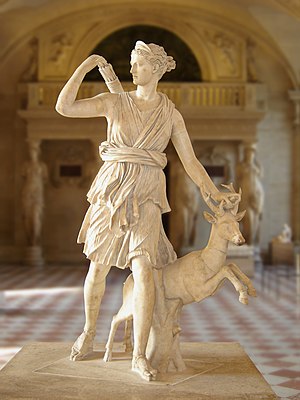
Of all the various characters of this goddess, there is no one more known than that of her presiding over woods, and delighting in hunting. The Diana Venatrix, or goddess of the chase, is frequently represented as running on, with her vest flying back with the wind, notwithstanding its being shortened, and girt about her for expedition. She is tall of stature, and her face, though so very handsome, is something manly. Her feet are sometimes bare, and sometimes adorned with a sort of buskin, which was worn by the huntresses of old. She often has a quiver on her shoulder, and sometimes holds a javelin, but more usually her bow, in her right hand. It is thus she makes her appearance in several of her statues, and it is thus the Roman poets describe her, particularly in the epithets they give this goddess, in the use of which they are so happy that they often bring the idea of whole figures of her into your mind by a single word. The statues of this Diana were very frequent in woods: she was represented there in all the different ways they could think of; sometimes as hunting, sometimes as bathing, and sometimes as resting herself after her fatigue. The height of Diana's stature is frequently marked out in the poets, and that, generally, by comparing her with her nymphs.
Of all the various characters of this goddess, there is no one more known than that of her presiding over woods, and delighting in hunting. The Diana Venatrix, or goddess of the chase, is frequently represented as running on, with her vest flying back with the wind, notwithstanding its being shortened, and girt about her for expedition. She is tall of stature, and her face, though so very handsome, is something manly. Her feet are sometimes bare, and sometimes adorned with a sort of buskin, which was worn by the huntresses of old. She often has a quiver on her shoulder, and sometimes holds a javelin, but more usually her bow, in her right hand. It is thus she makes her appearance in several of her statues, and it is thus the Roman poets describe her, particularly in the epithets they give this goddess, in the use of which they are so happy that they often bring the idea of whole figures of her into your mind by a single word. The statues of this Diana were very frequent in woods: she was represented there in all the different ways they could think of; sometimes as hunting, sometimes as bathing, and sometimes as resting herself after her fatigue. The height of Diana's stature is frequently marked out in the poets, and that, generally, by comparing her with her nymphs.


Subscribe to:
Posts (Atom)